“Too much of anything is bad, but too much champagne is just right,” as F. Scott Fitzgerald put it. With New Year’s Eve on the horizon, it’s a good moment to talk about sparkling wines — what Champagne is, how it differs from other bubblies, and how to pick a bottle you and your guests will enjoy.
Full disclosure: I don’t drink true Champagne every day. Most of what I enjoy is sparkling wine. But understanding the difference makes choosing a bottle easier and more fun.
What is Champagne? and what isn’t?
Strictly speaking, Champagne is a sparkling wine that comes from grapes grown in the Champagne region of France and is produced using the méthode champenoise (also called méthode traditionnelle). That simple rule helps: Champagne = Champagne region + Champagne method. Anything that doesn’t meet both conditions is a sparkling wine rather than Champagne.
All sparkling wines go through two fermentation stages. The first fermentation turns grape juice into wine. The second fermentation is what creates the bubbles: a measured amount of sugar and yeast is added, the resulting carbon dioxide is trapped, and bubbles form. The sugar left after the second fermentation determines the wine’s sweetness level.
When the second fermentation happens inside the bottle, using the traditional Champagne technique, you get that classic fine mousse and complexity associated with Champagne and other traditional-method sparklers. When the second fermentation happens in a large tank, that’s the Charmat method; the wine often tastes fruitier and has a livelier, less creamy bubble. Prosecco, many Cavas, and a number of American sparkling wines use the Charmat method.
Wine purists can be particular about terminology, and some people are quick to correct those who call all sparkling wine “Champagne.” It’s useful to know the distinction, but there’s no need to be pretentious about it. If you enjoy what you’re drinking, that matters most.
How do I find something I’ll enjoy?
Two straightforward factors to consider are bubbles and sweetness.
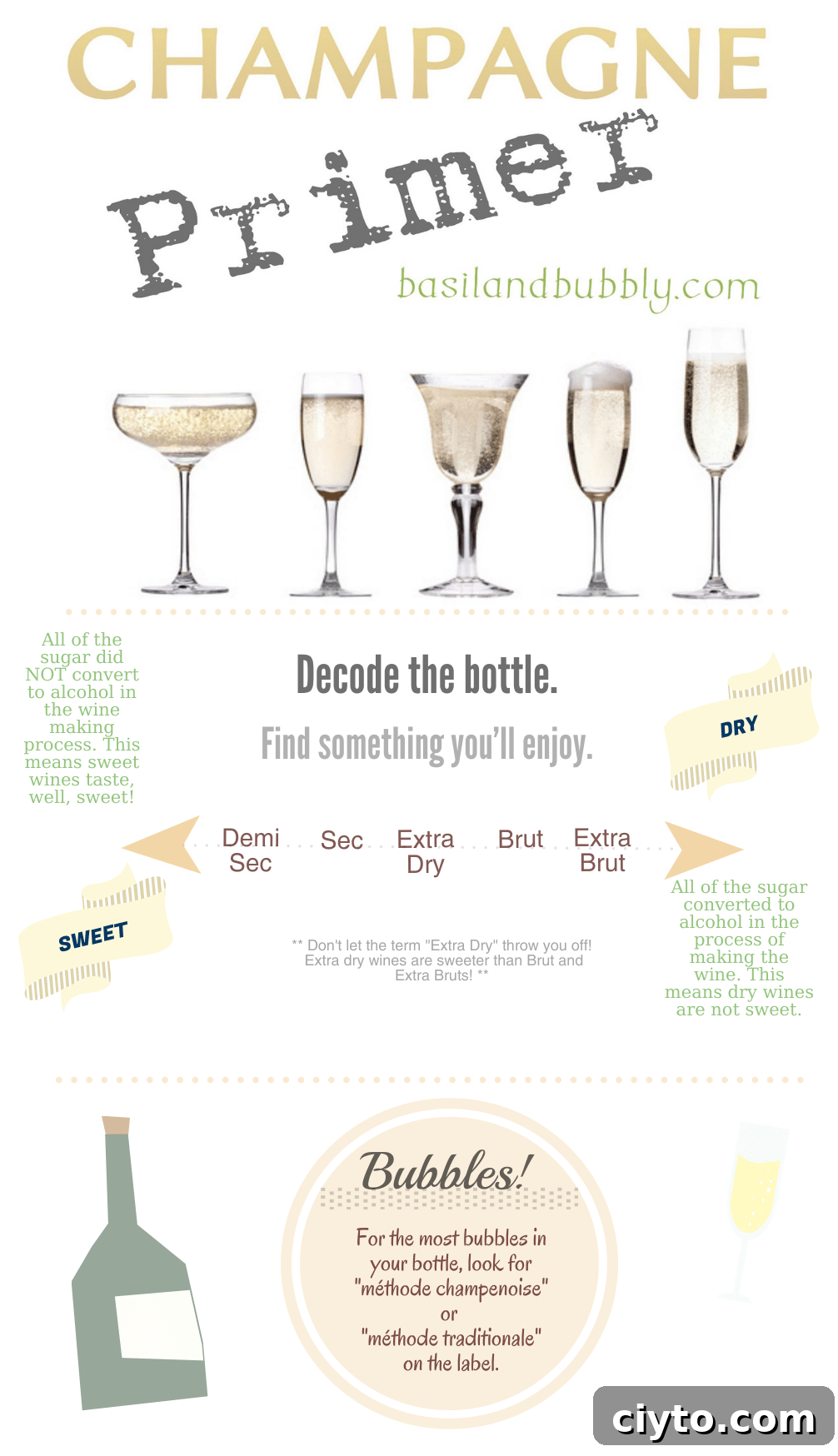
Bubbles: Traditional-method sparkling wines (including Champagne) usually have finer, more persistent bubbles. Some people prefer that texture; others find it more effervescent than they like. Charmat-method wines tend to have larger, brisker bubbles and a fruit-forward character. If the bottle label doesn’t say méthode champenoise, méthode traditionnelle, Champagne Method, or Traditional Method, it was likely made by the Charmat method.
Sweetness: Bottle labels use terms that can be confusing. Most traditional-method bottles you’ll see are labeled brut or extra brut — brut means dry, extra brut means very dry. Don’t be fooled by the term “Extra Dry” on some bottles: despite the name, “Extra Dry” labels often indicate a wine that is slightly sweeter than brut.
If you want Champagne-like character without the Champagne price, look for traditional-method sparkling wines from other regions. They usually capture the dryness and creamy bubbles you associate with Champagne but at a friendlier cost.
What do you recommend?
The Ritzy Gift:
- Veuve Clicquot “La Grande Dame” (Brut, France, $125)
- Domain Carneros “Le Rêve” (Brut, California, USA, $100)
- Taittinger “Comtes de Champagne” (Brut, France, $140)
The I-Thought-I-Wanted-Ritzy-But-Your-Ritzy-Is-Too-Ritzy Gift:
- Domaine Carneros (Brut, California, USA, $35)
- Perrier-Jouët Grand Brut (Brut, France, $40)
- Veuve Clicquot Yellow Label (Brut, France, $40)
The Boozy Bridal Shower:
- Sofia Blanc de Blancs Minis (Extra Dry, California, USA, $18)
- Domaine Chandon Rosé (Brut, California, USA, $17)
The Classy Budget New Year’s:
- Saint Hilaire Limoux Blanc de Blancs (Brut, France, $13) *
- Domaine Chandon Brut Classic (Brut, California, USA, $15)
- La Granja 360 (Brut, Spain, $7)
The My-Friends-Would-Drink-Mt-Dew-In-A-Flute-If-I-Didn’t-Stop-Them New Year’s:
- Freixenet Sparkling Cordon Negro Brut Cava (Brut, Spain, $10)
- Segura Viudas Brut Cava (Brut, Spain, $9)
*Saint Hilaire is my personal pick for Best Buy among these recommendations: good balance of quality and price.
If you have questions about styles, sweetness levels, or pairing sparkling wines with food, feel free to reach out through the About page on this site or find me on social media under the handle basilandbubbly. Enjoy exploring bubblies—cheers to finding the right bottle for your celebration.