Bread machines are available in several sizes, so I’m often asked how to adapt recipes to fit a machine of a different capacity.
Last Updated January 22, 2026 – Originally posted January 2, 2017
Featured Comment
This page has been the most help I’ve found for conversions. ~ Patricia
I own three different bread machines and use my two-pound machines for most baking. Because of that, many of the recipes here are written for the two-pound loaf. But since machines vary in capacity, the key skill is converting ingredient amounts so the dough and final loaf behave the same in a smaller or larger pan.
Below are clear, practical steps for converting recipes between sizes, plus tips on eggs, yeast and troubleshooting so your adapted recipe bakes reliably.
How do I convert a two-pound loaf recipe to another size?
The simplest approach is proportional math. For example, if a two-pound recipe uses 4 cups of flour and you want a one-pound loaf, divide the flour by 2 to get 2 cups. Apply the same conversion ratio to all other ingredients so the dough keeps the same hydration and balance of yeast, salt and sugar.
Write the entire recipe down before you start. Record the original amounts and the converted amounts. Keeping notes lets you compare attempts and saves time when you adjust the recipe later.
For intermediate sizes, use smaller increments. To convert a two-pound recipe to a 1.5‑pound loaf, first find the amount per half‑pound by dividing the two‑pound ingredient amount by 4, then multiply that result by 3 to reach 1.5 pounds. For example: 4 cups of flour ÷ 4 = 1 cup per half‑pound; 1 cup × 3 = 3 cups of flour for a 1.5‑pound loaf.
Expect some rounding. Use your best judgment and note exact measurements so you can fine‑tune on follow-up bakes. Pay special attention to the yeast amount after conversion — if it looks unusually high or low compared to typical amounts for your machine size, adjust the yeast slightly up or down.
What about the eggs?
Eggs can be tricky when scaling recipes. If a recipe calls for an odd number of eggs, beat the full eggs first and measure the volume you need. For instance, if a recipe uses 3 large eggs and you are reducing the recipe to a smaller loaf that needs about 1½ eggs, beat the 3 eggs and use roughly half the beaten mixture. This approach preserves liquid balance and helps the dough rise and bind properly.
Simply dropping from 1½ eggs to 1 whole egg can reduce liquid and affect texture, so measuring beaten egg by volume produces more consistent results.
When you make your converted recipe for the first time:
Follow your bread machine manufacturer’s instructions about ingredient order. After the machine has been kneading five to ten minutes, check the dough. It should form a smooth, round ball during the kneading stage.
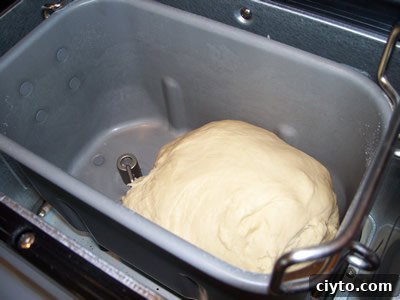
Smooth, round ball of dough
If the dough seems too dry, add liquid one teaspoon at a time until it rounds up properly. If it’s too wet and slack, add flour, also in teaspoon increments, until the dough reaches the desired consistency. Keep good notes about any changes so you can reproduce the result.
Tweaking the Recipe
Many conversions work well at the first try, but you may need two or three iterations to get a perfect loaf. Track each change you make so adjustments are simple and repeatable.
Common troubleshooting tips:
Loaf rose too much: Reduce yeast slightly or decrease liquid or sugar. Increasing salt a small amount can also slow fermentation.
Loaf didn’t rise enough: Try reducing salt, or increase yeast, liquid or sugar a little to boost activity.
Top of loaf cracked: This often signals a dry dough or too much surface tension. Try reducing flour slightly or adding a bit more liquid during mixing.
Crust too dark: Increasing the dough’s liquid by one to two tablespoons can moderate crust color. You can also use a lighter crust setting if your machine has one.
Converting recipes between bread machine sizes is mostly arithmetic plus careful observation. With a few practice loaves and clear notes, you’ll be able to adapt two‑pound recipes to any machine size and enjoy consistent, delicious homemade bread.