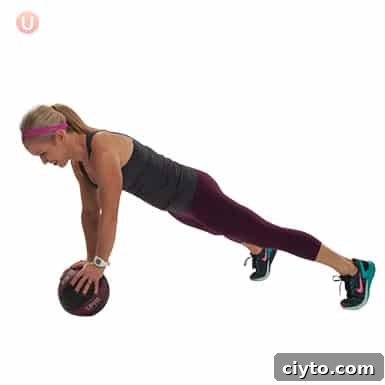
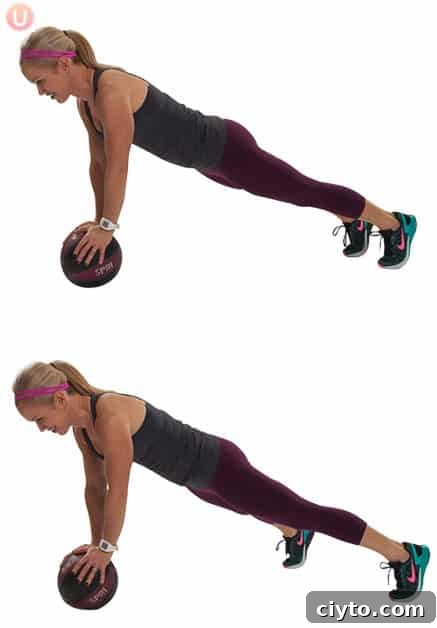
Medicine Ball Plank Jacks: A Core-Strengthening Exercise
Medicine Ball Plank Jacks are an effective core exercise that builds stability, endurance, and overall trunk strength. Placing your hands on a medicine ball creates an unstable base, forcing your abs, obliques, lower back, and shoulder stabilizers to work harder than when performing the same movement on a stable surface. This increased demand recruits more muscle fibers and improves balance and coordination.
Why include Medicine Ball Plank Jacks in your routine
This variation challenges the body in ways that a standard plank or traditional plank jack does not. Because your hands are elevated and positioned on a rounded surface, small adjustments from the arms, shoulders, and core are needed to maintain alignment. That increased neuromuscular demand enhances core control, teaches better spinal stability under dynamic load, and supports functional strength transfers to other movements and sports.
Benefits
- Improves core stability and endurance
- Strengthens shoulders, chest, and upper back stabilizers
- Enhances coordination and balance through an unstable surface
- Builds lower-body stamina when performed as a cardio-strength combo
- Accessible progression from standard plank jacks to more advanced core training
Equipment and setup
Use a medicine ball that is fully inflated and large enough for both hands to grip comfortably. Ball weight is less important than size and firmness for this move; the ball should provide a solid yet slightly unstable platform without flattening under your hands. A ball that is too small or underinflated will strain the wrists and reduce effectiveness.
How to perform Medicine Ball Plank Jacks
- Start kneeling on the floor and place both hands around the medicine ball so you have a secure hold.
- Tighten your abdominals and glutes, then step or kick your legs back until your body forms a straight line from head to heels. Keep your arms straight and shoulders pulled down away from your ears.
- Keeping your torso still and your core braced, jump your feet out to roughly shoulder-width apart, then jump them back together. Maintain a controlled tempo and avoid letting your entire body bounce up and down.
- Continue repeating the outward and inward jumps for the desired number of repetitions or time, focusing on stability and steady breathing.
Technique cues
- Keep your lower abs pulled in tightly as you move your legs. This prevents the hips from sagging or lifting and protects the lower back.
- Lock your shoulders in position over the ball and resist shifting your torso from side to side; the legs should provide the movement while the upper body stabilizes.
- Land softly on the balls of your feet to reduce impact and maintain rhythm.
- If your wrists become uncomfortable, verify the ball is fully inflated and choose one with a suitable diameter so your hands wrap naturally around it.
Common mistakes and modifications
A frequent error is allowing the hips to bounce or pike as the feet jump. This reduces core engagement and can strain the lower back. To correct it, slow the movement, focus on bracing the midline, and perform fewer reps with better control. If the full plank jack is too challenging, practice standard plank jacks on the floor with hands flat to the ground until your shoulders and core feel stronger. For a less intense option, step one foot out at a time instead of jumping both feet simultaneously.
Programming and progressions
Include Medicine Ball Plank Jacks in circuits, high-intensity interval training, or as a core finisher. Start with short intervals (20–30 seconds) and build to longer sets or increase repetitions as your stability and endurance improve. To progress the exercise, use a smaller ball for greater instability, add a push-up between jacks, or combine the move into a timed EMOM or superset with other core and upper-body exercises.
Targeted muscles
- Core (rectus abdominis and obliques)
- Lower back
- Shoulders and chest stabilizers
- Hip abductors and adductors through the leg movement
Medicine Ball Plank Jacks are a compact, challenging exercise that blends core strengthening with dynamic lower-body movement. When performed with proper form and a well-chosen medicine ball, they deliver efficient improvements in stability, strength, and conditioning.